How to Start Rucking
A Beginner's Guide to Rucking for Fitness, Fat Loss, and Strength

If you want to know how to start Rucking, here is the simple answer:
Start with a light weight in a comfortable backpack and walk for 20–30 minutes at an easy pace.
That is Rucking.
And for a lot of people, it is one of the best ways to get fitter without destroying their joints, overcomplicating their training, or needing a gym membership.
Rucking is simple, but it is not trivial.
There is a right way to start.
And there is the way most people start:
Too heavy.
Too hard.
Too much ego.
Bad backpack.
Sore knees.
Never do it again.
This guide will help you avoid that.
If you are a beginner, this is your complete guide to Rucking: what it is, why it works, what weight to use, what backpack to use, how often to do it, how to avoid knee and back pain, and how to make steady progress.
If you are wondering whether Rucking is good for fitness, fat loss, posture, endurance, or long-term health — the answer is YES.
Let’s get into it.
What Is Rucking?
Rucking is walking with weight on your back.

Usually that means walking or hiking with a weighted backpack, Ruck plate, or another secure load.
That is the whole idea.
Rucking started as military-style load carriage training, but today it has become one of the best forms of low-impact fitness for everyday people.
At Wild Gym, we think of Rucking less like military training and more like walking leveled up.
It is one of the simplest ways to combine:
- cardio
- strength
- posture
- endurance
- outdoor time
- mental resilience
In one session.
That is why so many people are turning to Rucking as a practical alternative to running, traditional cardio, or high-impact workouts.
What Are the Benefits of Rucking?
People often ask: Is Rucking actually a good workout?
Yes.
Rucking is one of the most effective and sustainable forms of fitness because it adds resistance to a movement pattern humans already do well: walking.
Key benefits of Rucking:
- burns more calories than regular walking
- builds leg, core, and upper back endurance
- improves cardiovascular fitness
- develops work capacity
- can help improve posture
- is lower impact than running
- can support bone and connective tissue strength
- gets you outside more often
- scales easily for beginners and advanced athletes

Rucking is not magic.
It is just a very efficient use of a basic human movement.
And that is exactly why it works.
Why Rucking Works So Well
A lot of training methods work for a few weeks.
Very few work for years.
Rucking works because it lives in a sweet spot between effectiveness and recoverability.
1. Rucking is more effective than regular walking
Walking is great. I recommend walking all the time.
But adding load makes your body work harder.
Your heart rate goes up.
Your muscles work harder.
Your trunk has to stabilize more.
Your posture matters more.
Your energy output increases.
So you get many of the benefits of walking — with a stronger training effect.
2. Rucking is lower impact than running
Many people want the fitness benefits of hard training but do not want the pounding of running.
Rucking gives you a way to train hard enough to matter without beating yourself up the same way.
That is a big deal, especially for:
- adults over 40
- former athletes
- heavier individuals
- people with cranky knees
- people rebuilding fitness

3. Rucking builds usable strength
Rucking is not just “cardio with a backpack.”
It is loaded movement.
That means you are developing:
- trunk strength
- posture under load
- leg endurance
- foot and ankle resilience
- real-world work capacity
It is strength that transfers.
4. Rucking fits real life
You can Ruck from your front door.
You can do it on a trail, in your neighborhood, while traveling, with your dog, with your spouse, before work, after dinner, or while listening to a podcast.
You do not need a gym.
You do not need machines.
You do not need a perfect schedule.
That simplicity is a feature, not a limitation.
How Rucking Can Improve Posture

One of the underrated benefits of Rucking is that it can help improve posture — if you do it correctly.
Most people spend a lot of their day folded forward.
Sitting.
Driving.
Working on a laptop.
Looking down at a phone.
Over time, that can create the familiar pattern of rounded shoulders, stiff upper backs, weak postural muscles, and a general collapsed feeling.
A well-designed Rucking backpack can help counter that.
When the load is packed correctly and carried close to your body, Rucking encourages you to stand taller, organize your trunk, and move with more intention. Your upper back, core, and postural muscles have to engage to support the load.
That is one reason Rucking can help people feel stronger and more “stacked” through their torso.
A good Rucking backpack matters here because it keeps the weight:
- high on the back
- close to your center of mass
- stable while you move
- secure without excessive bouncing
- That makes it easier to maintain better alignment.
Over time, Rucking can help reinforce:
- a taller standing position
- stronger upper back engagement
- better trunk stiffness and control
- more awareness of rib position and pelvic position
- less of that slumped, collapsed posture
Important: Rucking does not magically fix poor posture.
If you go too heavy, let the pack sag, and slump through every session, you can absolutely reinforce bad movement.
But when the load, backpack, and mechanics are right, Rucking can be an excellent posture-building tool.
Not fake posture.
Real posture.
The kind that comes from strength and awareness.
Who Should Start Rucking?

Rucking works for almost anyone who can walk and is willing to progress intelligently.
Rucking is especially good for:
- beginners who want a simple fitness routine
- people over 40 who want low-impact exercise
- walkers who want to burn more calories
- hikers who want more strength and endurance
- busy parents who need efficient workouts
- former athletes who want to feel capable again
- people who want cardio without excessive joint stress
- people trying to lose weight sustainably
- people who want to train outdoors
If you can walk, there is a good chance you can start Rucking.
You just need to start with the right amount of weight and the right expectations.
How to Start Rucking

If you are wondering how to begin Rucking, follow this sequence.
1. Start with a light weight
This is the biggest beginner mistake: starting too heavy.
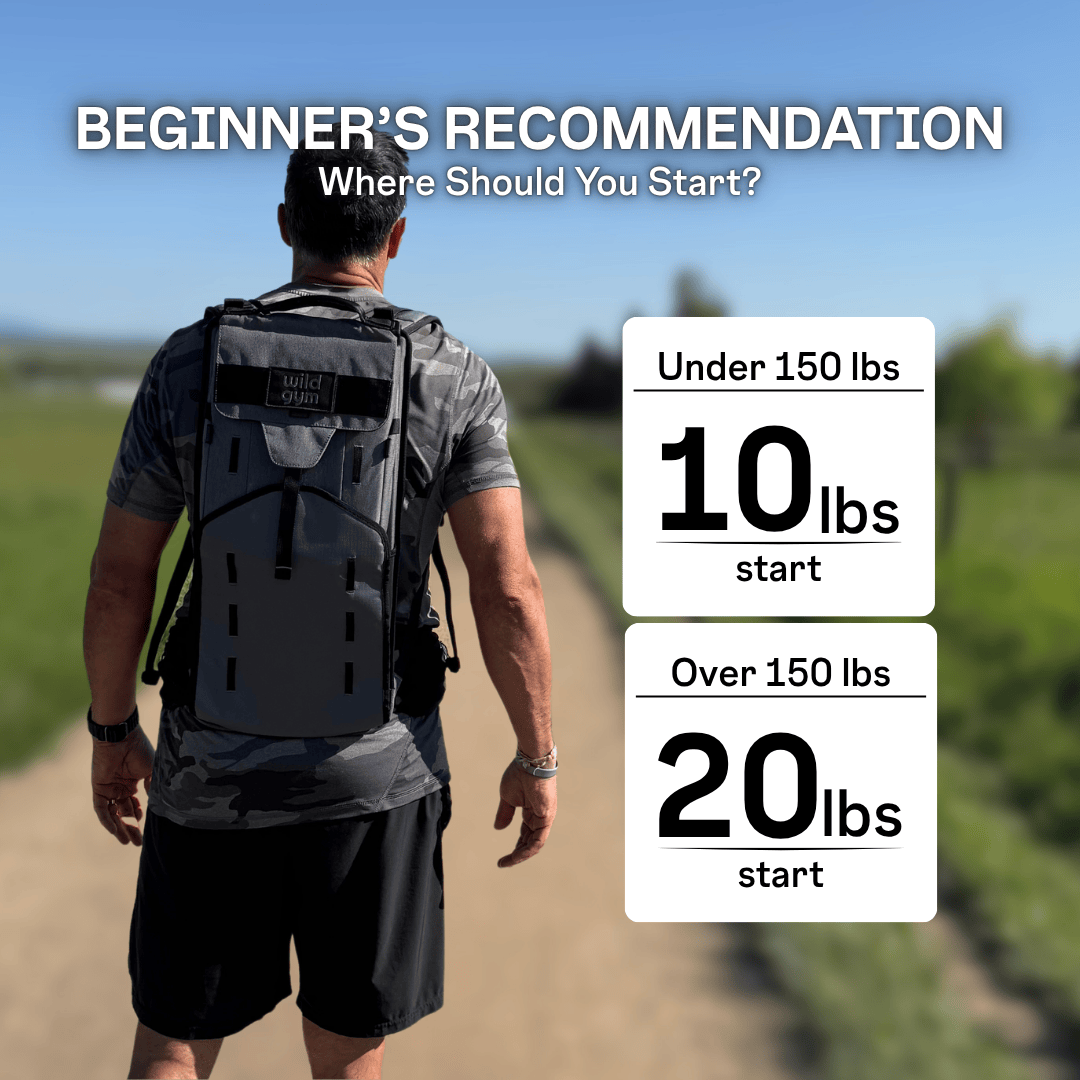
For most beginners, a smart starting point is:
- Women: 10–15 pounds
- Men: 15–20 pounds
If you are very deconditioned, recovering from injury, or returning to exercise after a long break, start even lighter.
Your first Ruck should feel manageable.
You should finish feeling like you could have done more.
2. Start with short Rucks
Your first Ruck does not need to be long.
Start with:
- 20–30 minutes
- or roughly 1–2 miles
This is enough to let your feet, joints, and posture begin adapting to load.
3. Focus on good Rucking form
Rucking technique does not need to be complicated.
Simple cues:
- stand tall
- keep ribs stacked over hips
- relax your shoulders
- keep the load stable and close
- take short, controlled steps
- lightly brace your trunk
- avoid excessive forward lean
Think athletic posture, not survival mode.
4. Use a backpack that carries weight well
You can start with a normal backpack.
But regular backpacks are often not built for load carriage. They sag, shift, bounce, and make Rucking less comfortable than it should be.
A good Rucking backpack should:
- hold the weight high and close
- stay stable while you move
- distribute load comfortably
- minimize bouncing
- be durable enough for repeated use
A better backpack does not just improve comfort.
It usually improves consistency too.
5. Progress slowly
Once your initial weight and distance feel easy, increase gradually.
A simple beginner progression:
- add 5 pounds
- or add 5–10 minutes
- or add one more weekly session
Do not increase everything at once.
Progression works best when it is boring enough to sustain.
Best Beginner Rucking Plan

If you are brand new, here is a simple beginner Rucking plan.
Weeks 1–2
- 2–3 Rucks per week
- 20–30 minutes
- light weight
- easy conversational pace
Weeks 3–4
- 3 Rucks per week
- 30–40 minutes
- same weight or a small increase
- add hills if available
Weeks 5–6
- 3 Rucks per week
- 35–50 minutes
- gradual load increase if recovery is good
- keep at least one session easy
This is enough to start building a strong base without overdoing it.
What Weight Should Beginners Use for Rucking?

This is one of the most common questions in Rucking.
The answer is simple:
Use less weight than your ego wants, and only add more when your body adapts well.
Good beginner Rucking weights:
- 10–15 pounds for many women
- 15–20 pounds for many men
- lighter if you are brand new, older, heavier, or coming back from injury
If your goal is general fitness:
Use a load that makes walking noticeably harder without wrecking your posture.
If your goal is weight loss:
Choose a moderate load you can use consistently 3–5 times per week.
If your goal is strength:
Build gradually toward heavier loads over time.
If your goal is longevity:
Stay in a zone where you recover well and can Ruck consistently for years.
Can You Start Rucking With a Regular Backpack?

Yes.
You do not need a purpose-built rucksack to begin.
A regular backpack can work, especially if you are just testing the waters.
If you use a normal backpack:
- pad the weight so it does not jab your back
- keep the load high in the bag
- pack it tightly so it does not bounce
- use less weight than you would in a dedicated Ruck
- make sure the straps are reasonably comfortable
That said, once you know you enjoy Rucking, a dedicated Rucking backpack is worth it.
A bag that carries load well makes a big difference in:
- comfort
- posture
- stability
- long-term consistency
What Is Better for Rucking: Ruck Plate, Dumbbell, or Weight Vest?

Ruck plate
Usually the cleanest option if your bag is designed for it. Compact, stable, and easy to secure.
Dumbbell or sandbag
Works fine in a pinch, but can feel awkward if not packed well.
Weight vest
A weight vest can be useful, but it is not the same thing as Rucking.
A vest distributes load differently and often feels hotter and more restrictive. If your goal is specifically Rucking, a proper backpack is usually the better tool.
What Pace Should You Walk When Rucking?
For beginners, most Rucks should be done at an easy-to-moderate pace.
A good rule:
You should still be able to hold a conversation.
That usually means:
- brisk walking
- steady breathing
- purposeful movement
- not racing
Most beginner Rucks do not need to be intense.
Think:
smooth, strong, sustainable.
Common Beginner Rucking Mistakes
Avoid these and you will progress much faster.
Starting too heavy
Your lungs may handle it before your joints and feet do.
Going too far too soon
A little goes a long way at first.
Using a bad backpack
Poor gear can make Rucking feel much worse than it should.
Ignoring posture
A slumped, unstable position under load usually catches up with you.
Treating every Ruck like a challenge event
Easy sessions count.
Neglecting mobility
Stiff ankles and hips can make Rucking harder on your knees and back.
How to Prevent Knee Pain While Rucking

A lot of beginners worry about knee pain.
The good news is that Rucking is often easier on the knees than running because it is lower impact.
But lower impact does not mean no responsibility.
If your knees hurt while Rucking, common causes include:
- too much weight too soon
- volume increases that are too aggressive
- stiff ankles
- poor hip mobility
- overstriding
- hammering downhill sections
- footwear that is not working for you
Simple fixes:
- reduce the load
- shorten your distance temporarily
- take shorter steps
- slow down on descents
- improve ankle and hip mobility
- strengthen glutes and trunk
- make sure the pack is stable
Pain is feedback.
Listen early.
Is Carrying Weight Bad for Your Back and Knees?
This is one of the biggest objections people have to Rucking.
And it is a fair question.
Because yes — carrying too much weight, too soon, with poor mechanics can absolutely irritate your back, knees, hips, or feet.
But that does not mean carrying weight is inherently bad.
The same principle applies to almost all training.
Running is not bad.
Bad progression is bad.
Squats are not bad.
Bad mechanics and overload are bad.
Rucking is the same.
Usually the real problem is one of these:
- the load is too heavy
- progression is too fast
- the backpack carries poorly
- posture is off
- stride mechanics are sloppy
- mobility and strength limitations are ignored
Your body is built to adapt to load.
That is one reason Rucking is so valuable.
With appropriate loading and smart progression, Rucking can help build:
- muscular endurance
- connective tissue resilience
- work capacity
- posture under load
- bone-supporting training stress
Load is not the enemy.
Unmanaged load is the enemy.
Is Rucking bad for your back?
Not inherently.
A well-fitted Rucking backpack and an appropriate load should allow you to stay upright, brace naturally, and move well.
Problems usually come from:
- floppy bags
- bouncing loads
- weight hanging too low
- too much load too early
- excessive leaning
- poor trunk control
A good backpack setup solves a lot of this.
Is Rucking bad for your knees?
Not inherently.
In fact, many people find Rucking more knee-friendly than running.
But if your ankles are stiff, your hips do not move well, your stride is too long, and you jump into heavy loads too quickly, your knees may complain.
The better question is not:
“Is carrying weight bad?”
The better question is:
“Am I carrying the right amount of weight, the right way, for my current capacity?”
That is the real issue.
Rules that keep Rucking joint-friendly:
- start lighter than you think
- progress slowly
- use a good backpack
- keep the load high and stable
- use short, controlled steps
- improve ankle and hip mobility
- do not try to prove something on day one
Done correctly, Rucking is not reckless.
It is practical load-bearing movement.
That is human.
Simple Mobility Work for Better Rucking

A little mobility work goes a long way.
You do not need an hour-long prehab session.
Before or after your Ruck, do:
1. Ankle rocks – 10 reps per side
Drive the knee forward while keeping the heel down.
2. Calf stretch – 30 seconds per side
Helps restore ankle mobility.
3. Hip flexor stretch – 30 seconds per side
Especially useful if you sit a lot.
4. Glute bridge – 10–15 reps
Helps wake up the backside.
5. Deep squat hold or supported squat sit – 20–30 seconds
Gives your ankles and hips a chance to open up.
That is enough for most people.
What Shoes Are Best for Rucking?
The best shoes for Rucking depend on terrain and personal preference.
For roads and neighborhood walks:
- stable walking shoes
- supportive running shoes
- light trail shoes
For trails and rougher terrain:
- hiking shoes
- trail shoes
- light hiking boots
What matters most:
- comfort
- stability under load
- no hot spots
- enough support for the terrain
Heavier is not always better.
How Often Should Beginners Ruck?
For most beginners, 2–4 Rucks per week is a great place to start.
A simple setup:
- 2 shorter weekday Rucks
- 1 longer weekend Ruck
That is enough to improve fitness, strength, and endurance without overwhelming recovery.
Is Rucking Good for Weight Loss?
Yes.
Rucking can be excellent for weight loss because it:
- burns more calories than normal walking
- helps preserve muscle better than cardio alone
- improves work capacity
- is easier to recover from than many high-intensity workouts
- is sustainable enough to do consistently
And consistency is what drives results.
Rucking is not a shortcut.
It is just a very effective tool.
Is Rucking Better Than Walking?
Walking is already a great habit.
Rucking is what happens when you want a stronger training effect from the same basic movement.
You do not need to replace all walking with Rucking.
A strong formula for many people is:
- walk often
- Ruck a few times a week
- strength train a few times a week
That combination works extremely well.
Is Rucking Better Than Running?
They are different tools.
Running can be great.
Rucking can be great.
Some people should do both.
But if you want:
- cardio
- strength
- posture
- outdoor time
- lower impact
all in one session, Rucking makes a strong case.
Especially if your body does not love pounding anymore.
Why Rucking Is One of the Best Ways to Train for Life

This is the part most generic fitness articles miss.
Rucking is not just exercise.
It is training for real life.
It teaches you to:
- carry load
- move under tension
- build endurance
- stay outside longer
- handle discomfort
- feel capable in your body
And because it is simple, it is easier to make it part of your actual life instead of just another temporary fitness kick.
That matters.
Because the real goal is not to crush one workout.
The real goal is to become the kind of person who keeps showing up.
How to Start Rucking This Week
If you want a dead-simple beginner plan, do this:
Day 1
20-minute Ruck
Light weight
Easy pace
Day 2
Rest or regular walk
Day 3
25-minute Ruck
Same weight
Focus on posture
Day 4
Rest or light strength training
Day 5
30-minute Ruck
Same weight
Finish feeling good
That is enough to start.
Nothing heroic.
Just real.
RUCKING FAQs
What is the best weight to start Rucking with?
Most beginners do well with 10–15 pounds for women and 15–20 pounds for men. Start lighter if needed.
How long should a beginner ruck?
Start with 20–30 minutes or about 1–2 miles.
Can I use a normal backpack for rucking?
Yes. A regular backpack can work to start, but a purpose-built rucking backpack is usually more comfortable and stable.
Is rucking good for fat loss?
Yes. Rucking can help with fat loss because it increases energy expenditure and is sustainable enough to do consistently.
Is rucking bad for your knees?
Not inherently. Poor progression, bad mechanics, and too much weight too soon are the usual problems.
Is rucking better than walking?
Rucking is not automatically better than walking, but it provides a stronger training effect by adding load.
Is rucking good for posture?
Yes, when done correctly with a stable backpack and good mechanics, rucking can help improve posture and trunk control.
How many days per week should I ruck?
Most beginners do well with 2–4 sessions per week.
Start Rucking with Gear Built for the Real World
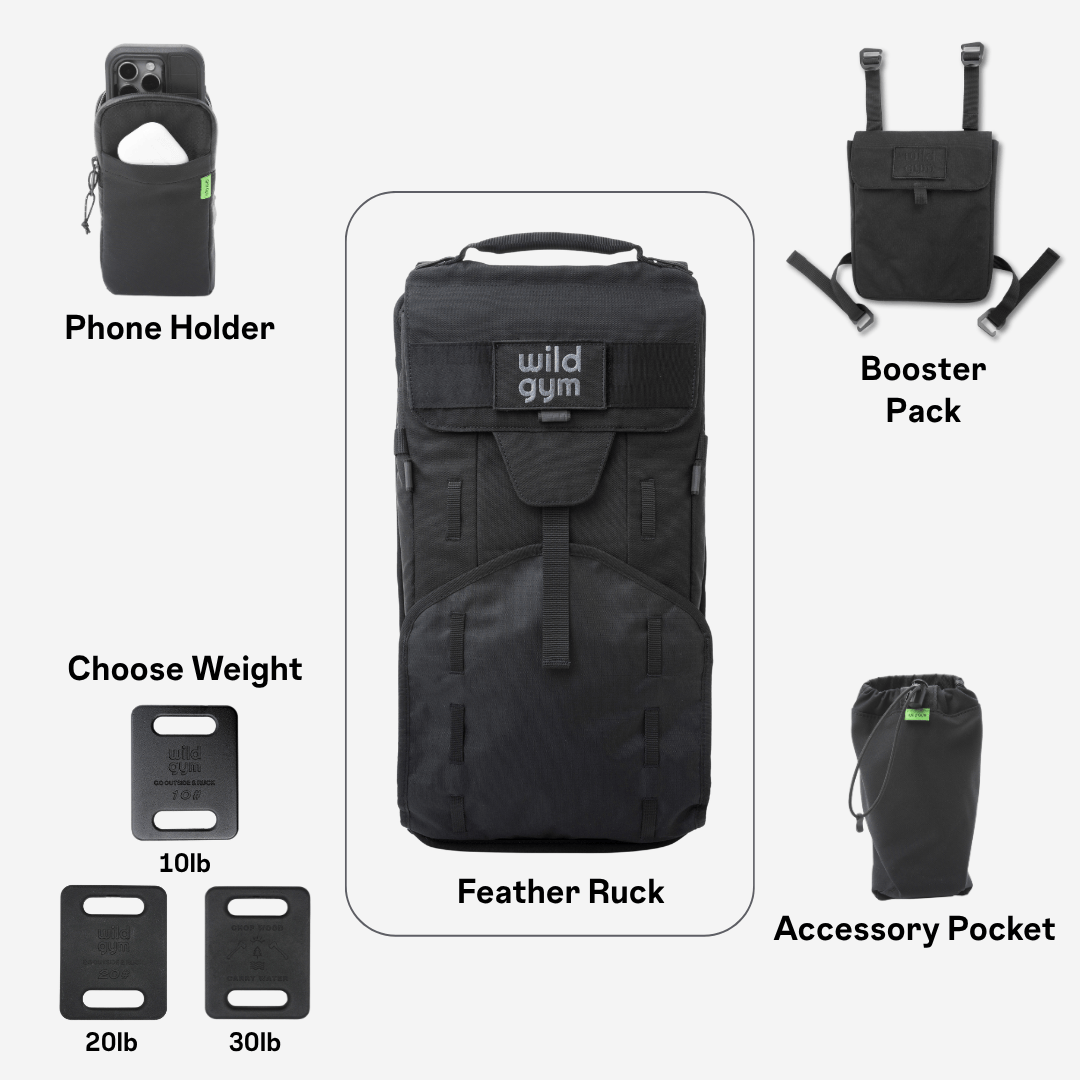
If you want a ruck that is designed to carry weight comfortably, stay stable while you move, and make rucking feel good from day one, check out the Wild Gym Ruck.
It is built for fitness, adventure, and everyday use — not military cosplay.
Featured collection